Hi Reader,
Funny thing is, I was using Trendos data before I ever got Gintare on her interview call for this week's piece.
A couple weeks back I was auditing my own site’s visibility in AI search. I pulled my Trendos score - 65.0, ninth in a set that included Y Combinator and Hawke Media - and handed it straight to Claude to ask what I should fix next.
That little hand-off, from Trendos to my own AI, felt like nothing in the moment. Turns out it’s the exact thing Trendos refuses to do for you... and it’s the whole reason a 4-month-old startup is winning AI search.
Then I got Gintare Rimolaityte, the Chief Commercial Officer at Trendos, on a call, and she said it plainly: that gap is the whole product strategy, and she designed it that way.
Here’s what I mean... every AI search tool out there is racing to bolt on recommendations. Trendos refuses. Gintare’s bet is that in an AI-native stack, the "what to do next" layer is already free, because your own Claude writes it the second you feed it clean data. So Trendos pours everything into data quality instead, and lets your agents do the strategy.
I track my own brand’s presence in AI answers every week, and I run this exact audit for the founders I work with. I built a 750,000-person organic audience without a dollar of ad spend by treating visibility as the engineering problem it is, so I read Gintare’s bet from inside the problem she built Trendos to solve.
WHAT WE DISCUSSED
- Why Trendos deliberately refuses to add AI recommendations, and why that refusal is fueling growth instead of stalling it
- The AI-native logic behind the bet: how large language models make the "what to do next" layer free, and push durable value into proprietary data
- The counterintuitive free-tier move: cutting free prompts from 100 to 20 and doubling paid conversions from 10% to 20%
- How Trendos gave away 600,000 prompt analyses for free to prove the AI search category was even real, before charging a cent
- The commercial design: per-prompt pricing instead of per-seat, monthly contracts as a wedge against annual lock-ins, and an enterprise motion that inbound demand pulled in
- Why Trendos ships an application programming interface and a Model Context Protocol server, so you can pipe AI-visibility data straight into your own agents and data lake
REFERENCED
- Trendos: trendos.com
- The answer engines Trendos monitors: ChatGPT, Gemini, Google AI Overview, and Perplexity
- Claude (Anthropic), for turning the data into a plan: claude.ai
- Model Context Protocol: anthropic.com/news/model-context-protocol
- Bing Webmaster Tools, for first-party citation data: bing.com/webmaster
- My Semrush AI Search Health audit, where I first used Trendos data: data-mania.com/blog/semrush-ai-search-health-audit
- Trendos Ad Radar, its ChatGPT-ads monitoring, and the top-1,000 most-visible-brands index that launches across the United States, the United Kingdom, and Germany
- Enterprise clients and ecosystem referenced: Hostinger, NordVPN, and the Tesonet group Trendos spun out of
- Competitor tools referenced: Profound and PKI
WHERE TO FIND GINTARE RIMOLAITYTE
MY BIGGEST TAKEAWAYS
-
The recommendation layer is a cost center in an AI-native stack. Before you build the next "what to do next" feature, ask whether your customer’s own AI already writes it from your data. If it does, you’re rebuilding something they get for free. That engineering belongs on the data only you can produce. This is the filter I now run over every AI-native roadmap I review.
-
Giving less away can convert more. Trendos cut its free tier from 100 prompts to 20, and paid conversions doubled from 10% to 20%. Here’s what I mean... free tiers convert on the value gap, not the value given. When your free tier fully solves the job, you’ve built a competitor to yourself. I see this exact trap when I audit product-led motions.
-
You can manufacture belief in a category before you sell into it. Trendos published 600,000 prompt analyses for free. They didn’t do it for lead capture. They did it to prove the AI search category was even real. The proof drove the traffic. The paywall came later, on the brand-specific insight.
-
Price for the way work actually happens. Trendos charges per prompt, never per seat. One client puts 50 people across SEO, paid, PR, and brand on a single account. Usage is where the value sits, so usage is what they meter.
-
Your competitor’s contract is your wedge. Rivals lock enterprises into annual deals. Trendos offers month to month, and will even match a competitor’s prompt credits to pull a trapped client out mid-contract. Fact of the matter is that confidence in the product becomes a pricing strategy, and it compresses the enterprise sales cycle to as little as one month.
-
Data quality is the moat when everything else is commoditized. Every hour Trendos didn’t spend building a me-too recommendations tab went into data accuracy instead. In a market where the AI does the analysis, whoever feeds it the cleanest, most accurate data wins.
-
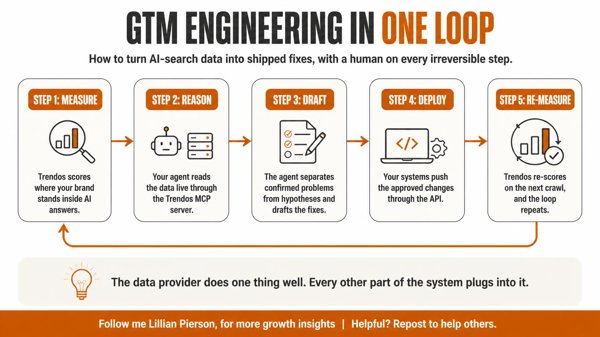
The build I keep coming back to is the loop I ran myself. Trendos measures where your brand stands in AI answers. Your agent reads that data live through the MCP server, drafts the fixes, and your systems deploy the approved ones. Then Trendos re-measures on the next crawl. That is GTM engineering in one workflow, and a human approves every step that can’t be undone. It is the same audit-observe-execute loop I ran on my own site, and the one I build into the systems I hand founders.
If you build go-to-market systems, or you’re deciding what belongs on your roadmap in an AI-native world, this conversation with Gintare is worth your time. What this comes down to is this... in an AI-native stack, the most valuable position is being the cleanest input in someone else’s workflow, ahead of trying to own the whole answer.
All the best,
Lillian Pierson
Fractional CMO & GTM Engineer
|