Real growth strategy from a startup CMO: The frameworks, interviews, & honest insights that 100k+ founders and operators actually use. The weekly newsletter by Lillian Pierson that cuts through the noise and gets straight to what works.
From a Borrowed Couch to Building a $4.5 Billion Company
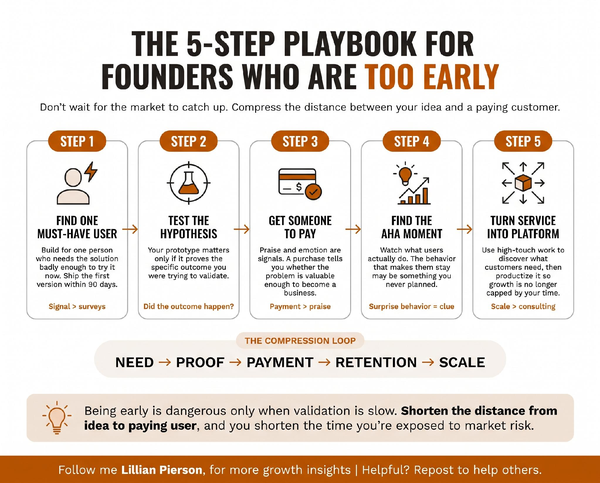
Hey Reader, Rob LoCascio's first company had just closed its doors. He was living on maybe $500 a month, showering at the New York Sports Club, and calling a sublet corner of an office home. He had a couch. He had an idea. So he taught himself to code. On that couch, he asked the question that became LivePerson: what if people could talk to each other, right there on a website? He invented web chat in 1997, patented it, took the company public in 2000, and grew it into a company that was worth about $4.5 billion at its peak, with half a billion in revenue and 3,000 employees. Then in 2023, he left the company that he founded and ran for 28 years, and he started over. And can you believe it, Rob still has that couch. He did not put it in storage either. I've designed multi-launch GTM strategies that pulled in $100K+ in pre-sales before a product shipped, so Step 3 below is the step that I would have you read twice. The key point being that only a payment suffices as validation, and everything that comes before it is simply a hypothesis. Rob runs a five-step sequence to build companies before their markets exist. Here it is end to end, and then I will walk you through what each step actually looked like in practice.
What We Discussed
Referenced
Where To Find Robert LoCascio
Biggest Takeaways1. Build for one person, and not for a segment. Rob's newest company started with a friend who posted on Facebook that he had 90 days to live. Rob reached out with a strange offer, and 90 days later that friend had the first Human Life Model. One person who needs your product badly enough to try anything will teach you more than a hundred survey responses. Name that person before you name your market. 2. Name the reaction you're betting on before you build. Rob's thesis was that an Individual AI would carry more emotion than a normal chatbot. He got his answer the first time his dying friend, Michael, and his wife talked to Michael's AI and started to cry. The real test is whether what you built produces the outcome you were after, and not whether it merely runs. Write the predicted reaction down first, then watch for exactly that reaction. 3. Emotion validates the thesis, and a purchase validates the business. Rob started charging $20,000 to hand-build these replicas one at a time, and he expected buyers who wanted to preserve someone before they died. Accountants, doctors, and lawyers showed up instead, wanting to replicate themselves alive so their expertise could operate without them in the room. Build around the requests that come from paying customers, and not around what people say they love. 4. The aha moment usually turns out to be a behavior you never designed for. Rob went looking within product analytics for the moment where users' eyes lit up, and he found people chatting with themselves. One customer, Brien, said his own AI gave him advice about his best friend that he never would have thought of on his own. That behavior became the core activation metric, which means the product now gets built around it. Go find the behavior your own users do that you never designed for. 5. Service revenue seems like a milestone, but it often represents a trap. "A lot of people stop there, and it becomes a consulting business," Rob told me. "They get no scale." The highest-leverage move is to build a platform underneath the service, and then price it low enough to serve millions of people. What Rob sold for $20,000 by hand now starts free. 6. Your moat is the data that nobody else can train on. General models train on what is already public. Uare.ai trains on your frameworks, your judgment, and your private corpus, and that data stays encrypted, isolated, and out of every public model. Scarcity plus trust is the defensibility, and both of those are engineering decisions you make before you write a word of marketing. 7. Plug into where the work already happens instead of fighting the ecosystem for attention. Uare.ai is Model Context Protocol native, so you connect 400+ applications to load your corpus, and then your Individual AI becomes an MCP itself with an API key that you can drop into Claude. Distribution is a product decision, and the earlier you make that decision, the less you will pay for traffic later. 8. Position toward what your prospects have to gain. Every other AI pitch sells automation, efficiency, and replacement. Rob sells abundance, ownership, and revenue that the customer drives themselves. In a market where your prospects are braced to lose something, your framing decides who you attract. 9. Borrowed distribution beats paid distribution at the cold start. Rather than buying traffic, Rob is bringing on creators who already have students and clients, investing in them, and letting them carry their audiences onto the platform. One math educator is bringing thousands of students from a decades-old teaching business onto his own Individual AI. Find the people who already own your audience, and give them a real reason to bring that audience with them. 10. The grind in the middle is where conviction erodes. Rob was honest about it in a way that most founders will not be, and he described waking up some days thinking that he sucks and that the thing does not work. He leans on the Spiritual Exercises of St. Ignatius, a structured practice that you can complete in about 28 days. You do not have to share his spiritual beliefs to take the point: when you are building before your market arrives, nobody hands you certainty, so you have to build your own source of it. If you're building for a market that hasn't arrived yet, you're in the good company of almost every AI founder I talk to right now. The question that actually decides your outcome is how well you survive the gap between where you're at now and where you'll be when the market is ready. Rob's sequence is the most practical answer to that question I've come across, and every step of it is something you can run this quarter.
All the best, Lillian Pierson Fractional CMO & GTM Engineer |
CONVERGENCE
Real growth strategy from a startup CMO: The frameworks, interviews, & honest insights that 100k+ founders and operators actually use. The weekly newsletter by Lillian Pierson that cuts through the noise and gets straight to what works.