Real growth strategy from a startup CMO: The frameworks, interviews, & honest insights that 100k+ founders and operators actually use. The weekly newsletter by Lillian Pierson that cuts through the noise and gets straight to what works.
How Synter audited 2 years of ads data in 3 minutes and found ~$15K of wasted spend
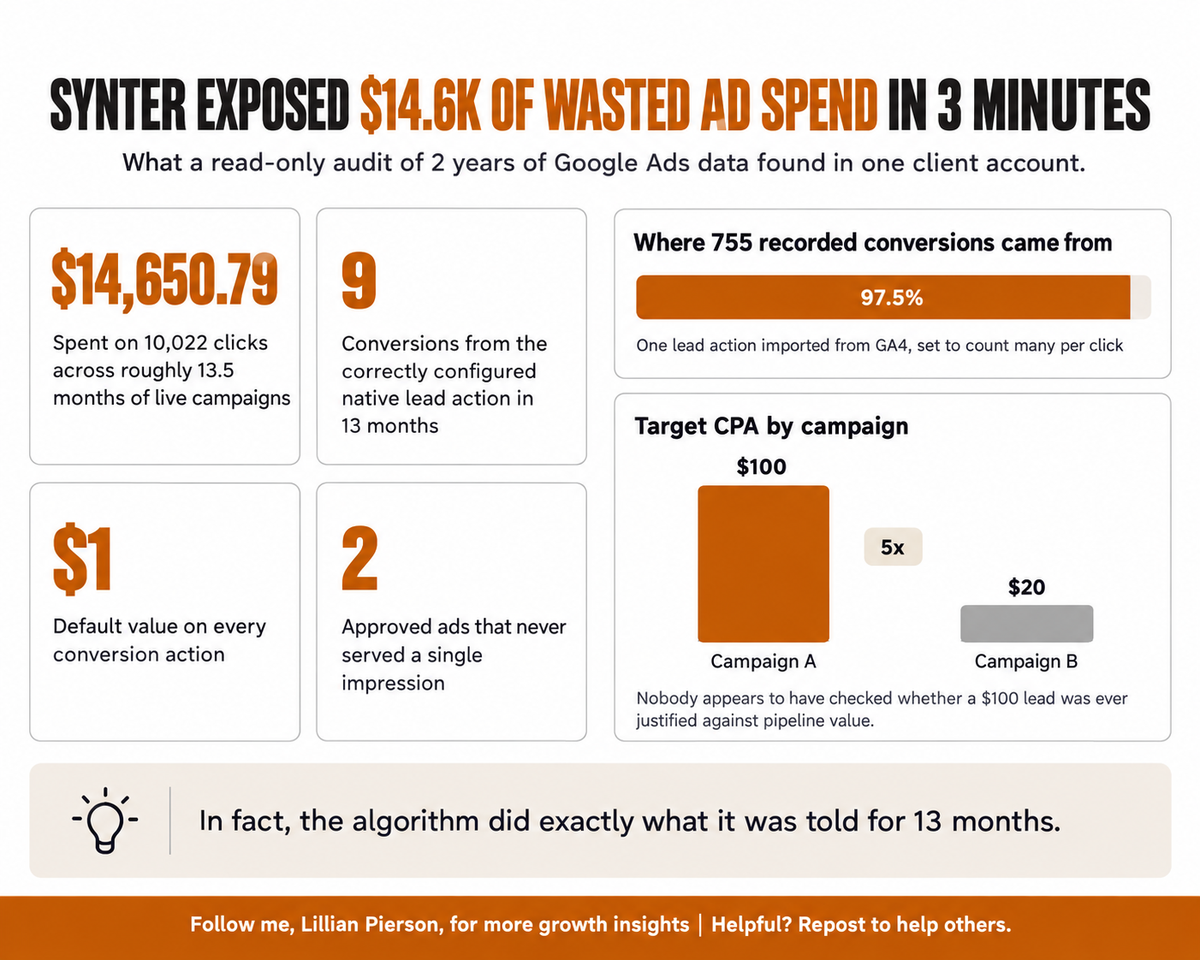
Hi Reader, If you run Google Ads with smart bidding, the accuracy of your conversion count will make or break your campaigns. Think about it... you give Google a target cost per lead, which is the most you’re willing to pay, on average, to win one lead. Google then raises or lowers every bid to hit that target. It judges its progress by counting your conversions, meaning the leads that it believes your ads produced. Google never questions that count. That means a wrong conversion count will, by default, steer every bid that Google places, even when your ads themselves are fine. I recently saw a wrong conversion count at work on a live video call with an enterprise AI client. While we talked, I used Synter to evaluate conversion tracking of my client’s Google Ads account. Synter is an agent platform for paid media that Joel Horwitz built after he ran growth for Amp at Sourcegraph. I asked Synter to audit how the account’s conversion tracking had been set up across the last 2 years of campaign data. About 3 minutes later, Synter gave me its answer. My client’s ads were fine. Unfortunately, the conversion count that Google had been optimizing toward for 13 months was categorically wrong. Google Ads had recorded 755 conversions. My client got zero leads. Over 95% of those recorded conversions came from a single lead conversion action that nobody had ever checked against a real lead. That action was even set to count repeat form submissions from the same click as brand new leads. With that setting in place, my client’s strongest campaign showed a cost of around $12 per lead. Synter put it plainly: “the number proving it’s good is the least trustworthy number in the account.” The account spent ~$15k over those 13 months. Every dollar of it went toward winning more conversions that never turned into a single lead. I've generated $7M+ in attributed revenue across product launches for tech startups of all shapes and sizes. Fact of the matter is that attributed revenue holds up only when each lead is counted once, where attribution traces every sale back to the lead that produced it. My client's $12 CPA failed that test. The conversion action behind it counted repeat submissions as new leads. That error carried into every number that was built on top of that conversion count. Here are the numbers that Synter's read-only audit pulled from my client's account.
Joel built guardrails into Synter to catch that kind of problem much earlier. When speaking with Joel about a month back, I asked about things like how he built the guardrails that sit around his agent (those guardrails have already cost him at least one deal). I also asked him how that deal fell apart… Read my full interview with Joel Horwitz on auditing the conversion count behind your ad spend
What We Discussed
Referenced
Where To Find Joel HorwitzBiggest Takeaways
In the full interview, I’m sharing the read-only audit that will return results on whether the conversion action that your bidding algorithm optimizes toward is counting each lead only once. That’s vital information as every bid that the algorithm places depends on that answer. In my client's account, Synter answered that question in about 3 minutes, after 13 months of spend had already gone out the door. I'm pointing Synter at the short-term rental homes that I manage next. Low season is when those homes need bookings most. Before my first low-season campaign goes live, I want Synter to audit the conversion tracking on my direct-booking site. If you run the audit on your own account, hit reply and tell me what your conversion count turned up. I'd love to compare notes.
All the best, Lillian Pierson Fractional CMO & GTM Engineer |
CONVERGENCE
Real growth strategy from a startup CMO: The frameworks, interviews, & honest insights that 100k+ founders and operators actually use. The weekly newsletter by Lillian Pierson that cuts through the noise and gets straight to what works.