Same product, two frames. One reframe took Stape from 10,000 to 200,000 customers.
͏ ͏ ͏ ͏ ͏ ͏ ͏ ͏ ͏ ͏
|
|
|
The Convergence
|
|
Founder-tested growth plays
|
|
|
|
September 4, 2026 · The Weekly Edition
|
|
|
200,000 customers by giving the product away
Same product, two frames. One reframe took Stape from 10,000 to 200,000 customers and opened the door to banks, insurers, and airlines.
|
¶ By Lillian Pierson, P.E.
|
8-minute read
|
Growth desk
|
|
|
¶ From the editor's desk
Hey Reader,
|
| I |
kid you not, I signed up for Denis Golubovskyi's product right in the middle of our interview.
|
|
|
I test a lot of products, and most of them make it hard for me to care. About 40 minutes into this interview though, I realized that I could go in and set up the exact server-side tracking that we were discussing, for free, so I did because, well, Google Analytics hasn’t been great for a very long time now.
|
|
Denis is the co-founder and CEO of Stape, a server-side tracking platform with more than 200,000 customers across 150+ countries. Stape has many open-source tools, it publishes full self-hosting guides that walk you through the work, and you don't pay a cent for any of it.
|
|
In all honesty, every founder instinct says that giving that much away is how you go broke. Stape does it anyway, and they do it well.
|
|
Now look at what Denis did with the frame around the product. I've put the two frames side by side for you here...
|
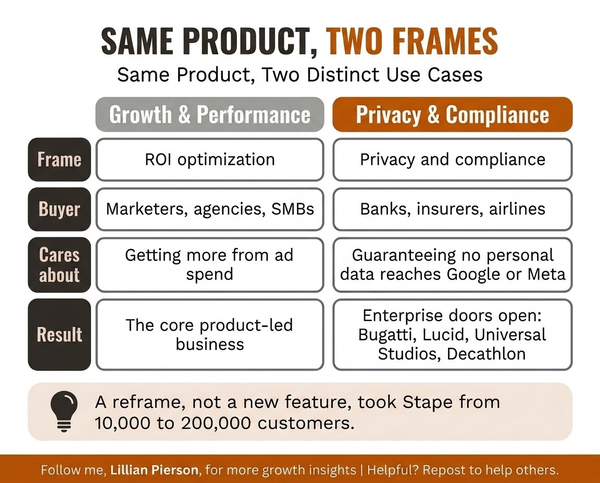
❧ The same product, framed two ways, sold to two different rooms.
|
|
Notice who sits in each column.
|
|
Under the ROI optimization frame, the buyers are marketers, agencies, and small and medium businesses… they want more return from the ad spend that they already commit.
|
|
Under the privacy and compliance frame, the buyers are banks, insurers, and airlines… they want a guarantee that no personal data ever reaches Google or Meta.
|
| |
|
« The same Stape product sits underneath both columns »
|
| |
|
|
I want you to sit with that for a second.
|
|
The ROI optimization frame built Stape's core product-led business. The privacy and compliance frame won contracts with Bugatti, Lucid, Universal Studios, and Decathlon.
|
|
I've driven $7M+ in attributed revenue across product launches for companies from Perion to IBM and SAP, and on most of those launches the revenue moved most when I changed the ICP segment and marketing to whom the product was sold.
|
|
|
|
§ 01 · What we discussed
|
| 01 |
Two frames, two rooms
How the same server-side tracking product sells on ROI optimization to marketers and agencies, and on privacy and compliance to banks, insurers, and airlines, and which enterprise accounts that second frame won.
|
| 02 |
Idea to 3,000 customers
How Denis and his co-founder went from idea to first release in 2 months, to a real product in 5 months, to 3,000 customers in the first year, because they productized server-side tagging into a one-click setup while Google's own documentation was still thin.
|
| 03 |
Giving away the funnel
Why Stape gives away its open-source tools, its full self-hosting guides, and its free MCP servers, earns nothing on any of them, and still treats all of it as the top of the funnel.
|
| 04 |
Support and content as one team
How Stape runs support and content as one team, where the person who couldn't find an answer to a ticket writes the next blog post, and why about 20 posts was the threshold where inbound momentum took over.
|
| 05 |
Humans on support, on purpose
Why Denis keeps humans on support on purpose while the rest of the industry races to hand that function off to AI.
|
| 06 |
Activation as the real bottleneck
Why activation is Stape's real bottleneck right now, and what the free tools, the guides, and the human support are all engineered to shorten.
|
|
|
§ 02 · Referenced
|
|
|
|
§ 03 · Where to find Denis Golubovskyi
|
|
|
|
§ 04 · Biggest takeaways
|
| 01 |
A second market needs a second frame
Marketers, agencies, and small and medium businesses buy Stape to get more from their ad spend. Banks, insurers, and airlines buy the same thing to guarantee that no personal data reaches Google or Meta. Before you scope your next build, write down the second frame that your existing product already satisfies, and go identify who buys under that frame.
|
| 02 |
Give away what buyers could do but never will
A marketer can self-host the open-source version of server-side tracking, and almost none of them ever want to, because server setup isn't the skill that they were hired for. The skill gap that you're tempted to hide behind a paywall is usually the lead magnet that you already own.
|
| 03 |
Speed at the front of the free tier
You can set up a Facebook Conversions API integration on Stape in about 5 minutes, and Denis has a YouTube video that shows it done in 1 minute, just to prove how fast it goes. Time the path from signup to first working result in your own product. Treat that number as a growth metric.
|
| 04 |
Fuse support and content into one team
Of Stape's 110+ employees, roughly a third work in support and content, and Stape runs them as a single team. When a customer asks support something and no blog post answers it, the person who couldn't find the answer writes that post. Every gap in a customer's understanding becomes published education, so you no longer have to overplan your content calendar.
|
| 05 |
Free education is a slow start that compounds
Because Stape committed to server-side tracking earlier than almost anyone in the category, those support-desk articles almost always landed on the first page of Google, and after about 20 posts the inbound momentum was inevitable. You pay a lot up front for this model, so if you're entering a crowded category, expect the compounding to take longer than it took Stape.
|
| 06 |
Keep humans on support on purpose
While the rest of the industry races to hand its support function off to AI, Denis deliberately keeps people running his support desk, because most of his customers don't fully understand what the product actually does, so they need to talk to a real person who does. In this model your support desk is the input to your content, and that content brings the next wave of free-tool signups.
|
| 07 |
One paid option, placed where self-service gets hard
Don't scatter upsells across the product. Put a single, obvious install-for-me button at the point where most people stop being able to finish the setup on their own, and the buyers who value convenience will pay for it without anyone selling to them.
|
| 08 |
Let the free layer qualify demand
The free tier pre-sorts buyers by willingness and by skill, so your paid motion only ever touches people who have already decided that they want the outcome. Stape keeps 90% of its customers self-serve and still lands names like Bugatti, Lucid, Universal Studios, and Decathlon.
|
| 09 |
Your best marketing will expose your real bottleneck
Denis was direct with me about this. The marketing works and the leads keep coming, and the breakdown happens after signup (because server-side tracking is technical and plenty of people register and then never finish the setup). The freemium tier, the guides, the free tools, the human support, and the install-for-me button all exist to shorten the time between signup and the aha moment.
|
| 10 |
Your expertise is not the moat you think it is
Denis started out by handing people the instruction manual so they could run the transformation themselves, and hoarding that knowledge rarely protects anything. The startups that give the knowledge away and then engineer one clean path from “I get it now” to “do it for me” are the startups that tend to wake up with 200,000 customers and wonder how it happened.
|
|
|
§ 05 · Next steps
|
|
If you sell something technical, four of the ten moves above run as a single loop:
|
| ❧ |
Give away the work that requires a skill your buyers could develop but don’t want to |
| ❧ |
Turn every answer to a previously unanswered ticket into a new published article |
| ❧ |
Place one paid option at the moment that creates the most friction before a free trial user can get the full transformation |
| ❧ |
Let your free tier qualify demand |
|
|
You will find that each stage produces the input that the next stage needs.
|
|
Lastly, run Stape's Website Tracking Checker against your own site. If the amount of ad spend that you're likely losing to broken tracking is high enough to bother you, you'll understand in about 90 seconds why so many of those 200,000 people started with the free version and then converted to paid.
|
|
Enjoy this one. Denis told me plainly which parts of his model still don't work.
|
|
|
|
|
|
200,000
Customers
|
150+
Countries
|
110+
Employees
|
|
|
|
| |

|
All the best,
Lillian Pierson
Fractional CMO & GTM Engineer
|
|
|
|
|
|
|
|
The Convergence
Published weekly by Data-Mania, LLC
Written and edited by Lillian Pierson, P.E.
1321 Upland Drive #1454, Houston, Texas 77043
|
|
|
|
|