profile

CONVERGENCE

How Payment Labs managed 0 churn & 37% bigger renewals over the last 2 years


Hey Reader,

You've seen this photo a hundred times. An angler stands on a podium at the end of a fishing tournament, holding an oversized $1 million novelty check while the cameras go off.

Funny thing is, I bet you never knew that the check is a prop.

Han Park, the CEO and founder of Payment Labs, told me that the moment the check goes up, somebody backstage is often only just starting to collect the angler's banking details, personal information and tax documents. Before Payment Labs, the fallback was often a bag of cash (literally) or a stack of pre-signed checks with a blank name line.

"Which is open to fraud and check washing and all these other different things," Han told me.

Han's team reversed the order of the payout process. On Payment Labs, every competitor is onboarded before anyone casts a line. By the time the final weights come in, you're looking at a field of anglers who are already verified and compliant. The prize money then reaches each angler's account by same-day bank transfer before they leave the tournament.

Ironically, you'd never see a minute of that work from the stands. Neither does the next league that Payment Labs wants to sign.

If your product does its best work where your prospects can't see it, you're absorbing the repercussions of that lack of visibility in every sales cycle, where every prospect who has never heard your name has to be convinced from scratch, one conversation at a time.

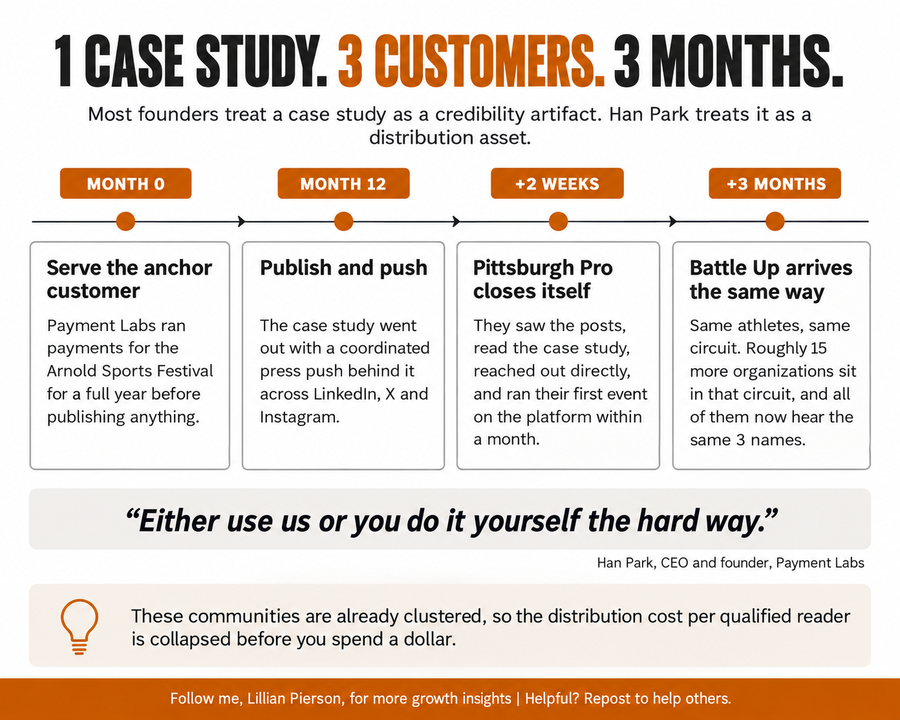
Han's answer to that invisibility was one case study. Payment Labs ran payments for the Arnold Sports Festival, a bodybuilding event, for a full year before it published a word about the work. Within 3 months of publishing, Han had 3 customers on the same bodybuilding circuit instead of 1.

"When we go to any of them now, we just say we're powering Arnold, Pittsburgh Power and Battle Up," Han said. "Either use us or you do it yourself the hard way."

I'm a fractional CMO and licensed Professional Engineer. I've driven more than $7 million in attributed revenue across product launches, from VC-backed startups to IBM and Intel. One of the things I love about Han’s GTM approach is how he treats each published case study as a product launch.

What We Discussed

  • Why the $1 million novelty check on the podium is a prop, and what Payment Labs finishes before the first line goes in the water
  • The baseball prospect who told Han that his pitch was wrong, and the second line of business that came out of that conversation
  • How Han picks his next vertical, and how he gets a meeting with the league that he wants
  • How one published case study brought in 3 customers in 3 months, and the one condition that makes a case study fall flat
  • Why Payment Labs underpriced a 6-event pickleball league that now pays out $4 million a year
  • How renewals come in 37% higher on average while the base price never moves

Referenced

  • Payment Labs, Han's payments platform for competitive sports, which handles the compliance and tax work that has to happen before the money moves
  • Amplemarket, the sales intelligence platform that comes up in Han's account of how Payment Labs enters a new vertical

Where To Find Han Park

Biggest Takeaways

  1. Payment Labs does its best work before the event starts, behind the stage, where no prospective league is watching. If your product's value lacks visibility at the moment that you deliver it, publishing the proof is your job, because your next customer will never see the work on their own.
  2. Han's team assumed that the sales motion that won X Games would carry into every sport. A baseball prospect showed them otherwise. That one objection opened a second line of business for Payment Labs. When you carry a winning pitch into a new vertical unchanged, you can lose every deal in that vertical.
  3. In fact, Han's read on cold outreach right now is blunt: "It's just way too much garbage floating out there. You're being bombarded nonstop, and it's really hard to filter the noise." Every cold email that you send into a new vertical competes with that noise. The full interview shows you the route that Han takes instead.
  4. Unfortunately, a case study is only as strong as the volume behind it. Han walked me through a scenario where a league plans $3 million in payouts across 6 events, then runs only 3 events that pay out $300,000. When a customer under-delivers on volume, you lose the proof that you were counting on, even though nothing went wrong with the customer or the product.
  5. Payment Labs signed the Association of Pickleball Players 3 years ago, when the league ran 6 events and paid out roughly $300,000 in prize money. Today the league runs 25 events and pays out $4 million. If you price an early customer only for what it's worth today, you can lose the account that it grows into. Han is equally clear that the bet only pays off on a league that has a real market behind it.
  6. Renewals at Payment Labs come in 37% higher on average, with no churn across 2 years of sports customers. Han gets there without one specific conversation on a renewal call. "We're not going there and saying we're going to double the size of the contract because you're stuck on our platform. That's terrible," he said. Squeezing a customer who feels stuck on your platform turns the renewal into a negotiation, when it could have been a planning conversation about what they need next.
  7. Han wants Payment Labs to be the Stripe for sports, so that anyone in competitive sports who needs to move money thinks of his company first. Most of the leagues that need a partner for prize money and contractor payouts have yet to hear the Payment Labs name. A distribution problem is an enviable one to be left with when the compliance and tax infrastructure that nobody else wants to build is already complete.

If you sell infrastructure that your customers only notice when something goes wrong, Han's story applies to you, whatever vertical you sell into.

Truth be told Han has already built the compliance and tax layer that the big payment companies treat as an edge case. What's left is more (and faster) distribution.

Han and I covered a lot of ground in this interview... from the $1 million novelty check all the way to the pickleball bet that now pays out $4 million a year. Enjoy!

All the best,

Lillian Pierson

Fractional CMO & GTM Engineer

CONVERGENCE

Real growth strategy from a startup CMO: The frameworks, interviews, & honest insights that 100k+ founders and operators actually use. The weekly newsletter by Lillian Pierson that cuts through the noise and gets straight to what works.

Share this page