Real growth strategy from a startup CMO: The frameworks, interviews, & honest insights that 100k+ founders and operators actually use. The weekly newsletter by Lillian Pierson that cuts through the noise and gets straight to what works.
How Amro Elmasry turned one question to a Cisco rep into Bank of China as a client
Hey Reader, Picture a race garage in Australia on a Sunday afternoon. About 20 screens cover the wall, and every one of them is streaming live sensor data off a car that is somewhere out on the circuit. Tire temperatures, engine load, telemetry that nobody in the room fully parses in real time. A prospect is standing in front of those screens. He is a CFO, or maybe an IT director, and 3 weeks ago he would not even return a phone call. Nobody is pitching him. The person who explains the screens works for the race team, and that person is telling this prospect what Extranet Systems does for the team. Amro Elmasry paid to set that scene. I spent an hour with Amro for this feature, and the same instinct shows up in all four of his growth plays. A normal founder buys the outcome. Amro buys the mechanism that produces the outcome. He did not ask Cisco for leads. He asked Cisco's account managers which of their deals were stuck, and that one question opened an account list that eventually included Bank of China. He did not rent capacity from a hyperscale cloud provider either. He spent a few million dollars on his own infrastructure and AI cluster so that nobody else could set his prices. And while most of the AI companies I talk to are bolting services onto their software because delivery became the moat, Amro is running the other direction. Extranet is about 60% product and 40% services today, and he forecasts 80/20 next year. I've designed multi-launch GTM strategies that pulled in $100K+ in pre-sales before the product existed, and that only worked because the acquisition motion was built before there was anything to sell, which is exactly what Amro is doing right now with the product-led growth motion for PentestOps.
What We Discussed
Referenced
Where To Find Amro Elmasry
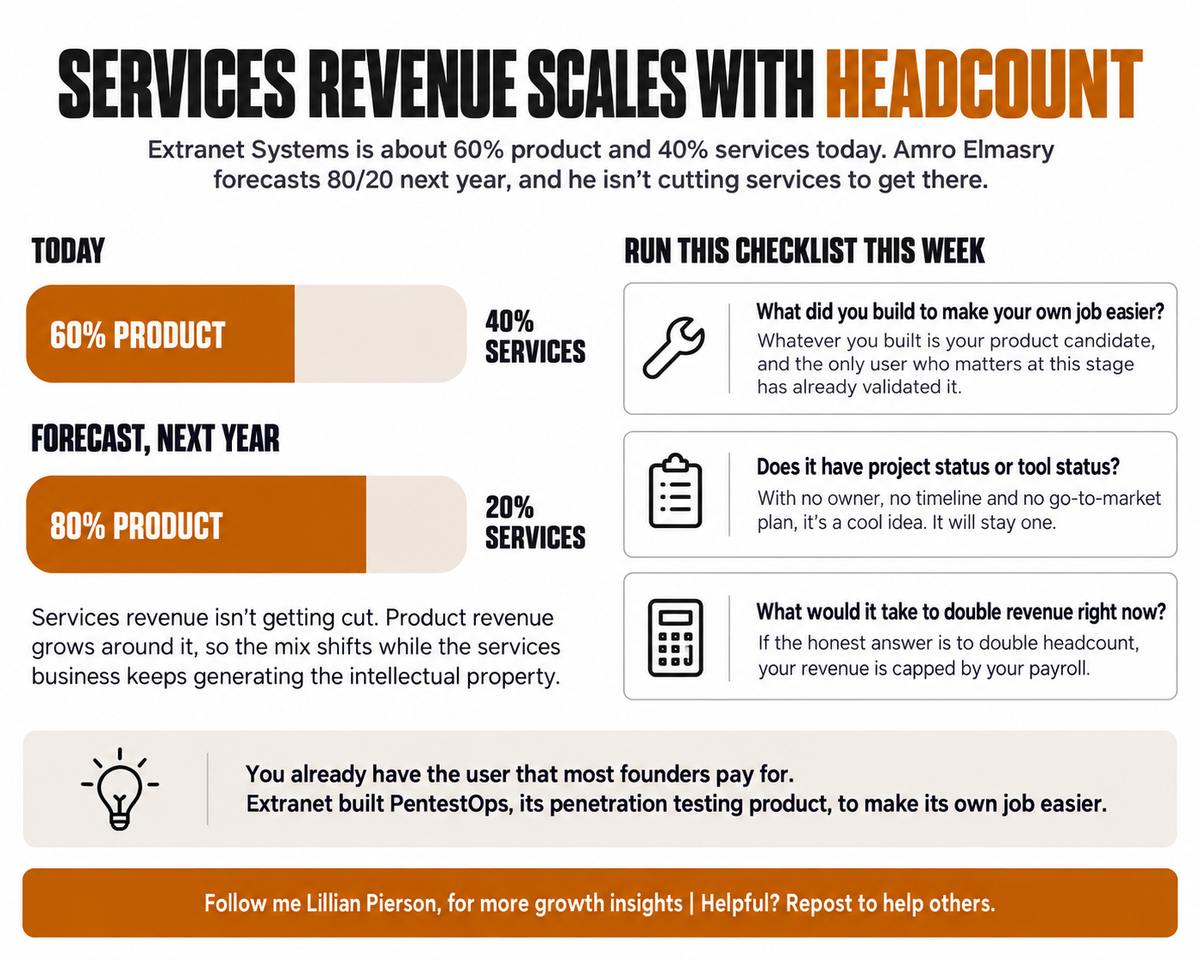
Biggest Takeaways1. Every vendor partnership that you already hold is sitting on a list of stalled deals, and the account manager who owns those deals is the person to talk to. Ask which deal is stuck behind a dependency that nobody owns, and offer to unblock it. Amro went to individual Cisco account managers with that question instead of asking the vendor for leads, and the response he got was remarkable. 2. Certification signals commitment, because somebody has to pay to get engineers certified. The account list opens after you close a deal and deliver the project, and never before that point in time. Amro was precise about the sequence: they had to prove they could do it first, and only then did the account managers start referring customers to them. 3. Pick 2 or 3 vendors and go deep on them. Deep knowledge of one vendor beats surface knowledge of everything, and it lowers your vendor risk at the same time. Amro also screens out vendors that sell direct, because you can deliver the work and then watch somebody else take the account. 4. A sponsorship is worth signing when you can answer yes to both questions: do you deliver real work to the team, and does that team give you access that your buyer cannot get anywhere else? Extranet supplies Brad Jones Racing's actual technology, which turns the sponsorship into a reference customer that runs live telemetry off a moving race car. Amro estimates a 30% lift in engagement in the 12 months after signing, though he was careful to tell me that he did not have the exact numbers in front of him. 5. The reference customer does the selling for him. Amro lets the Brad Jones team tell his prospects what Extranet does for them, so he does not have to sell them anything. A weekend environment where enterprise buyers show up as VIP guests does work that a boardroom meeting cannot do. 6. Run the price control test before you build on anybody else's infrastructure: if their price doubles tomorrow, are you still competitive? Extranet priced the virtual machine at about $120 and the estimated egress on that same workload at about $3,000, and that gap is what sent them to spend a few million dollars on their own AI cluster. The infrastructure serves every product that they will ever ship, so they launched one product and can launch 10 more on the same platform. 7. Amro's technical team wanted to cap tokens and his sales team refused, and he sided with sales because token caps annoy him as a buyer. PentestOps sells unlimited AI on a fixed monthly fee, sized on graphics processing unit memory and processor capacity per month, and he has not yet seen a customer choose the metered option. Owning the infrastructure is what makes that pricing possible, and it doubles as a data privacy feature, because a customer's findings never reach a third-party model provider and the data stays in Australia. 8. If you sell services, your revenue scales with your headcount. Amro put the arithmetic plainly: fifty people produce a certain revenue, and doubling that revenue means hiring another fifty people, which is a very slow way to grow. Those 7 years of solved enterprise problems, in regulated industries and across 4 countries, are the makings from which the product gets built. 9. The product candidate is usually already inside the company. PentestOps started as an internal tool that Extranet built to make its own penetration testing work easier, so it was validated by the only user who mattered at that stage. Amro's regret is the set of generative AI tools that his team built and liked and never treated as products, and then he watched other companies ship products for problems that he had already solved. 10. Product status means an owner, a timeline, and a go-to-market plan. These things make up the gap between an internal tool and a company. In Amro's words, "The only difference we did with that project is we treated it as a product, not as a tool to use internally." 11. The motion that sells your services will not sell your product. Extranet launched PentestOps into its existing customer base, which is the obvious first move, and Amro already knows where it caps out. He is building the product-led growth motion now, specifically so that he is not scrambling for it in 6 months. Service providers who resell PentestOps are the first motion, and he reaches those providers at industry events like Cisco Live and MSP Global. 12. His current blocker is buyers who freeze, and those buyers are generally just postponing the decision (rather than rejecting the offer). This stall shows up almost entirely in cold traffic, because his existing customers have the relationship and some commercial flexibility to carry them through it. His partial answer is monthly pricing with no lock-in, a trial on every tier, and published head-to-head comparisons against the named platforms in his category. If you're running a services business right now, and the honest answer to "what would it take to double revenue" is "double headcount," Amro's story is the one to sit with this week. The product candidate is usually already inside the company, and it is the tool that somebody built so they could stop doing something manually. Run this checklist this week:
If you're the founder who has three of those tools sitting in a repository with no owner and no timeline attached to them, that is the gap that's probably worth closing before somebody else ships your idea as their product.
All the best, Lillian Pierson Fractional CMO & GTM Engineer |
CONVERGENCE
Real growth strategy from a startup CMO: The frameworks, interviews, & honest insights that 100k+ founders and operators actually use. The weekly newsletter by Lillian Pierson that cuts through the noise and gets straight to what works.